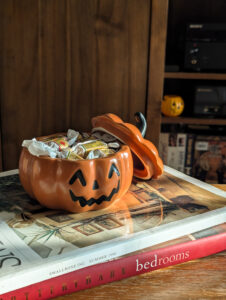
Can I really trust myself around halloween candy? a therapist's take.
It starts with one mini Snickers. Then maybe a Kit Kat. Before you know it, you’re knee deep in a pile of wrappers, wondering how something as small as a Halloween treat bag managed to hijack your entire evening.
If you’ve ever felt out of control around Halloween candy, you’re far from alone. And no, it’s not because you have “no willpower” or “a sugar addiction.” It’s because your brain and body are responding to years of mixed messages about food, control, and self-worth.
As a therapist who helps people untangle food guilt, anxiety, and perfectionism, I’m here to tell you: yes, you can trust yourself around Halloween candy. But first, let’s look at why it can feel so hard.
Guilt and Control Aren’t Great Dinner Guests
Let’s talk about food guilt. That uncomfortable voice in your head that narrates your snack choices: “You didn’t need that second chocolate. You’re being bad.”
Here’s the thing… Guilt and shame don’t help us eat “better.” They just make us feel worse. And when you’re someone who leans toward perfectionism, guilt often throws you into an all or nothing spiral. You go from having strict rules during the day to throwing them out the window by night.
This isn’t a discipline issue. It’s about your nervous system. When you restrict and shame yourself, your brain stays on high alert. Candy starts to feel like something forbidden, and once you finally let yourself have it, your body reacts like it’s a high stakes emergency instead of a casual snack.
The Restriction-Rebound Cycle Is Real
One of the most important things I teach my clients is this: restriction leads to obsession.
When you tell yourself you can’t have something, your brain zeroes in on it. That’s not a character flaw… It’s biology. Your brain doesn’t understand that you’re trying to be “good.” It thinks food is scarce, so it ramps up your desire for it.
Then when candy becomes available, like at a Halloween party or in your kid’s trick or treat stash, it feels almost impossible to eat it in a calm, connected way.
So what does trusting yourself actually look like?
Giving yourself full permission to eat candy anytime, not just on special occasions
Making sure you’re eating enough throughout the day so you’re not ravenous later
Slowing down and actually tasting what you’re eating instead of zoning out
Candy Doesn’t Need a Moral Label
Food isn’t good or bad. You’re not a better person because you chose celery, and you’re not a failure because you had a peanut butter cup.
When we label food with morality, we end up labeling ourselves. That’s a fast track to shame. And when you combine that with black and white thinking, it makes it hard to feel at peace with food.
Try asking yourself curious questions instead of judging yourself:
What am I craving right now and why?
Do I even like this candy, or am I eating it just because it’s there?
How do I want to feel after I eat this?
Questions like these help you tune into your body. It’s really about listening to yourself.
Your Nervous System Needs Some Love Too
Sometimes it’s not really about the candy. If you find yourself feeling overwhelmed, anxious, or scattered, food might be acting as a coping tool, one your body knows how to reach for quickly.
This doesn’t mean you’re doing something wrong. It means your nervous system might be in fight or flight mode, and eating becomes a way to try and calm the chaos.
When you learn how to regulate your nervous system, whether through movement, or just checking in with how you’re feeling, it becomes easier to respond instead of react. That’s what real food trust looks like. Not avoiding candy at all costs, but knowing you have a choice about how to respond.
You Deserve a Relationship with Food That Feels Peaceful
The goal isn’t to be someone who forgets candy exists. The goal is to know it’s there and still feel calm about it.
This work isn’t really about candy. It’s about rebuilding your relationship with food, your body, and your inner voice.
If Halloween has you feeling anxious or stuck in guilt, start small. Let yourself have the candy. Stay curious. Be kind to yourself.
And if you’re looking for more support, therapy can help. This is what we do at Modern Psych — real-talk, neuroscience informed support for high achievers who want to feel better.
Because life’s too short to let a fun sized chocolate bar ruin your night.
Ready to shift your relationship with food for good? Book a free consult or explore how our virtual therapy sessions can support you.