Stop Tracking Everything: Set Goals That Match Your Capacity
A lot of people don’t realize how much mental energy they spend tracking their own life until they intentionally stop for a moment and notice the discomfort that surfaces. There’s often a subtle internal unease, a sense of “something feels off,” even when nothing is actually wrong. It usually starts innocently by tracking tasks.. Which then leads to tracking a daily routine, goals, productivity and then the progress that comes with it. Then before you know it, one day you notice you’re not really using tracking to stay organized, you’re using tracking to feel steady.

In our Self-Growth Guide, we name a version of this as the inner project manager, the part that’s always monitoring how you’re doing, questioning whether you’ve been productive enough, whether you’ve earned rest, whether you’ve done things right, and always suggesting there’s more you should be doing. If that voice feels familiar, it makes sense. Most of us were trained into metrics long before we chose them… For example, most people’s work rewards output, life in general rewards performance and numbers feel clean or like some sort of proof that tells you where you stand.
And the thing is, tracking does give relief. It gives your mind a map when everything feels like it’s moving too fast, and your brain doesn’t love ambiguity. When the plan is clear, you feel calmer and when the plan is unclear, the mind starts scanning, predicting, rechecking, and looking for something measurable to stand on. That’s why tracking tends to get louder when life gets heavier.
The problem is that a dashboard never says done. It just updates. So if your goals have started to feel like a constant audit, or you can’t tell the difference between being motivated and being on alert, you’re probably not dealing with a discipline issue. You’re dealing with a capacity issue.
Capacity is the part most goal setting advice skips.
Your capacity changes. It changes with stress, sleep, workload, emotional load, transitions, the season you’re in, and the invisible stuff you’re carrying that isn’t on your calendar but still takes up bandwidth. When goals are built for a fictional version of you who has endless energy and a perfectly predictable week, then that goal will only work until real life happens! And then… when the goal starts to feel heavy, and the mind responds the way it always does when it feels behind. It tightens…tracks harder and adds pressure.
That’s usually where people start saying they’re inconsistent, or unmotivated, or that they just need to be more disciplined, when what’s actually happening is that the goal was never designed to flex with someone’s real capacity.
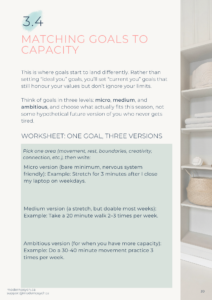
One Goal, Three Versions
This is why one of the pages we built into the guide is Matching Goals to Capacity, also known asOne Goal, Three Versions. It’s simple on purpose. It asks you to choose one area, like rest, boundaries, movement, creativity, connection, and write the micro version, the medium version, and the ambitious version, then choose what fits this season instead of chasing the version of you who never gets tired.
That structure changes everything because it takes goals out of the all or nothing lane. Micro is not a failure. Micro is the version that matches reality on a low capacity day. Medium is the version that fits most weeks. Ambitious is for the weeks where you have more room. Now you can track capacity for information instead of evaluation. You can notice which version you chose and why, without turning it into a verdict.
The guide even prompts you to notice the gap, which version you wish you were at, which version you’re actually at, what emotions show up there, and what supports would help you move from micro to medium if that’s something you want. That’s the part that matters, not the performance but the actual pattern!
Because once you start tracking capacity, you start seeing real data, like how certain weeks aren’t “bad weeks,” they’re heavier weeks, or how your ambitious goals tend to show up when you’ve slept, eaten, and had fewer meetings, which is not a character revelation, it’s just information.

Old Metrics vs New Metrics
The second page we bring in here is Letting Go of Hustle Metrics, Old Metrics vs New Metrics. This page is a reset for how success gets defined in the first place. Old metric success often sounds like never miss a day and always give 100 percent. New metric success sounds like notice capacity and adjust when needed. Old metric rest is allowed only when everything is finished. New metric rest is allowed when your body is asking for it, even if your list isn’t done.
That shift matters because a lot of tracking pressure isn’t really about productivity. It’s about reassurance. It’s about trying to feel like you’re doing life correctly. And if the only metric your brain respects is output, then you’ll keep chasing output, even when your system is tapped out.
So if you’re trying to stop tracking everything, you don’t need to stop paying attention. You need to change what you’re paying attention to.
Instead of tracking your worth through output, track capacity through signals. How much room do I have today? How reactive does everything feel? How easy is it to focus? How hard is it to start? Those are the signals that tell you which version of a goal actually fits, and when you respond to those signals early, you’re less likely to end up in that familiar loop where you push until you crash, then call it a motivation problem.
What we want is sustainable productivity. The kind that doesn’t require a full nervous breakdown as proof that you tried hard enough.
If you want a really practical way to use the for this, treat these two pages as your check in. Pick your one goal and write the three versions. Then decide what success means this week using the old metrics vs new metrics prompts. That combination tends to calm the inner project manager, not by arguing with it, but by giving it a better job.
And if you want support applying this to your real work life, the version with deadlines and pressure and a calendar that does not care how you’re feeling, we offer free consultations at Modern Psych. It’s a simple first step, and it helps you figure out what kind of support would actually make a difference.